Empty-state landing
When no method is selected in the sidebar, Bowire renders a context-sensitive landing page. It detects one of eight distinct states (seven in v2.0, plus the v2.1 workspace-required state) and shows the guidance relevant to that situation — the first-run welcome, a workspace-required prompt, a multi-URL status table, a discovery-failed error, or the "ready" summary once a service is connected.
State 8 — workspace-required (new in v2.1)
The workbench booted without an active workspace and the install isn't configured to seed a default. Bowire surfaces a friendly prompt asking the operator to create a workspace before any other state can resolve.
- Headline: "Pick a workspace to continue"
- Primary CTA: + Create workspace — opens the create dialog (name, color picker, optional URL seed)
- Secondary CTA: Import .bww file — drops the import flow
- Tertiary: link to the Workspaces topic in the Help rail
The state appears the first time Bowire is launched on a fresh machine (or after a workspace delete leaves the list empty). Standalone Tool installs seed a default workspace on first boot so the state is rare; embedded hosts that mount MapBowire() without seeding hit it on every fresh visitor.
State 7 — ready (the most common)
You've connected to a server, services have been discovered, and you just need to pick a method.
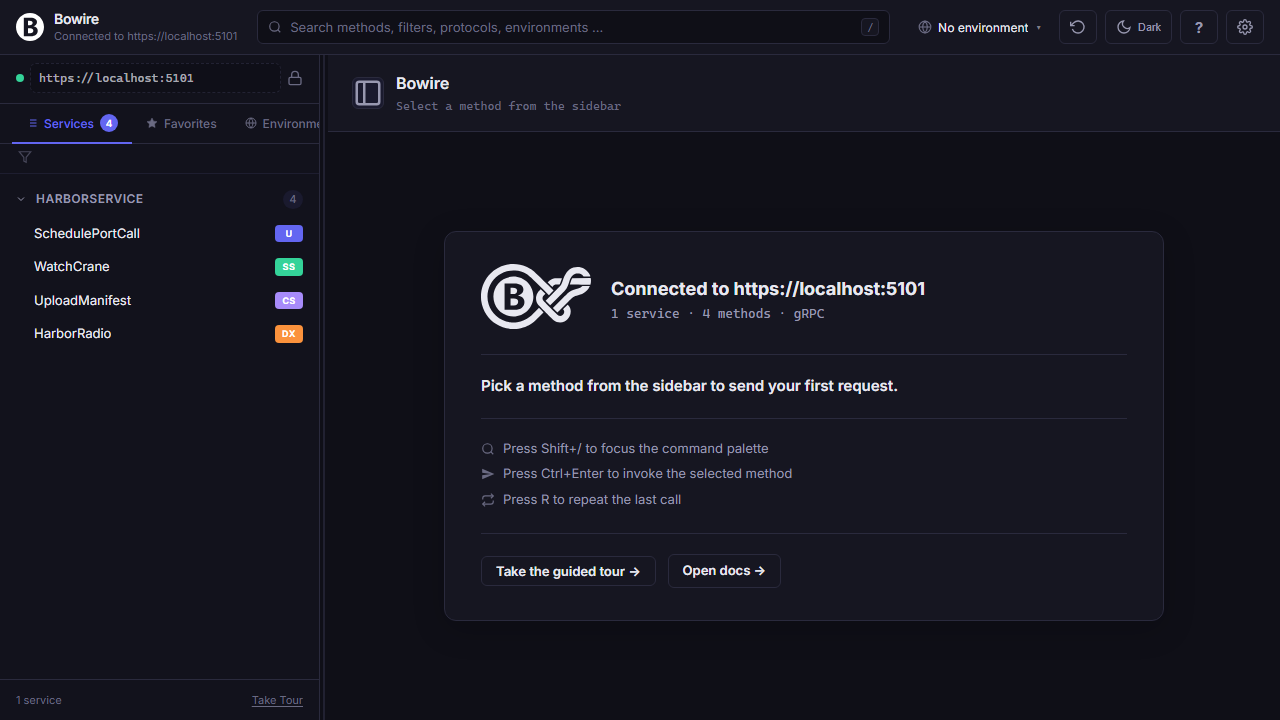
The ready landing shows:
- Bowire mark + headline: "Connected to https://localhost:5001"
- Service summary: "1 service · 4 methods · gRPC" (computed from
the live
servicesarray, supports multi-URL setups) - Recent history quick-recall: when there are previous calls in the history that match the currently discovered services, they're rendered as one-click recall rows. Click any to jump back into that method with the last-used request body
- Keyboard shortcut tips:
/to focus the search,Ctrl+Enterto invoke,Rto repeat - Footer: Take the guided tour, Open docs
State 6 — first-run
Bowire started without a --url flag and there's no proto upload
yet. Two onboarding cards: connect to a server, or upload a schema.
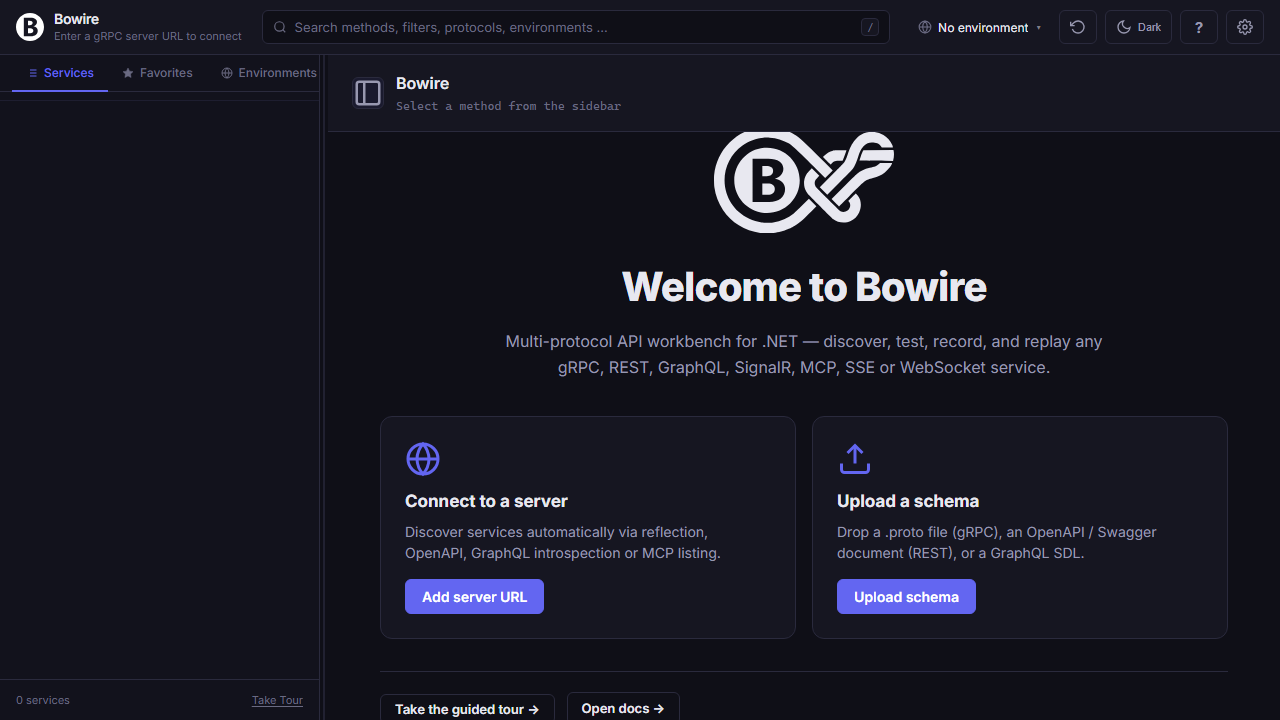
- Welcome to Bowire hero with the full Bowire rope-loop logo
- Connect to a server card → opens the URL input flow
- Upload a schema card → switches to proto / OpenAPI / GraphQL upload mode
- Footer with guided tour + docs
State 4 — discovery-failed
A server that didn't respond with discoverable services. Reached from a
locked-mode startup, and — since v2.3 — also from an embedded host whose
own /api/services probe failed. That second case used to fall through to
the first-run welcome hero, which hid the failure entirely: an embedded
host has no serverUrls and usually no lockServerUrl, so no earlier
check matched it.
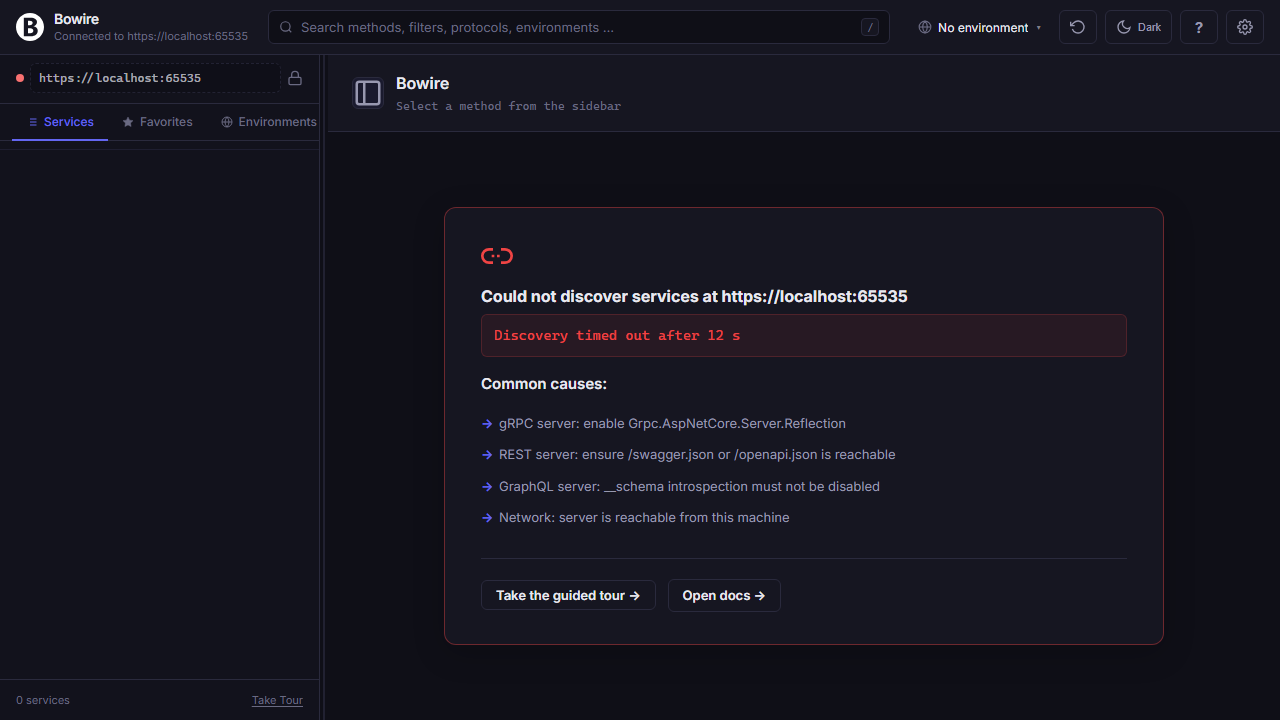
- Red disconnect icon
- Title with the failed URL (or "this host" for the embedded probe)
- Error box with the actual
discoveryErrors[key]message (HTTP status, exception message, or server-returned error envelope) - Per-plugin diagnostics (v2.3): a disclosure chip reading
12 plugins probed · 3 failed. Expanded it lists one row per plugin — outcome dot, plugin name, message, probe duration — sorted failures first, followed by theprotocol@pinning hint and a Copy diagnostics button. See Auto-discovery → When discovery finds nothing. - Four generic troubleshoot bullets — shown only when no per-plugin attempts came back. A concrete list of who tried what strictly dominates generic advice, so the two never appear together.
- Footer with docs link
State 2 — multi-url-partial
Multi-URL setup where some discovery URLs succeeded and others didn't. Shows the per-URL status table with retry buttons for the failed ones, plus a hint that the user can still pick a method because services from the working URLs are available.
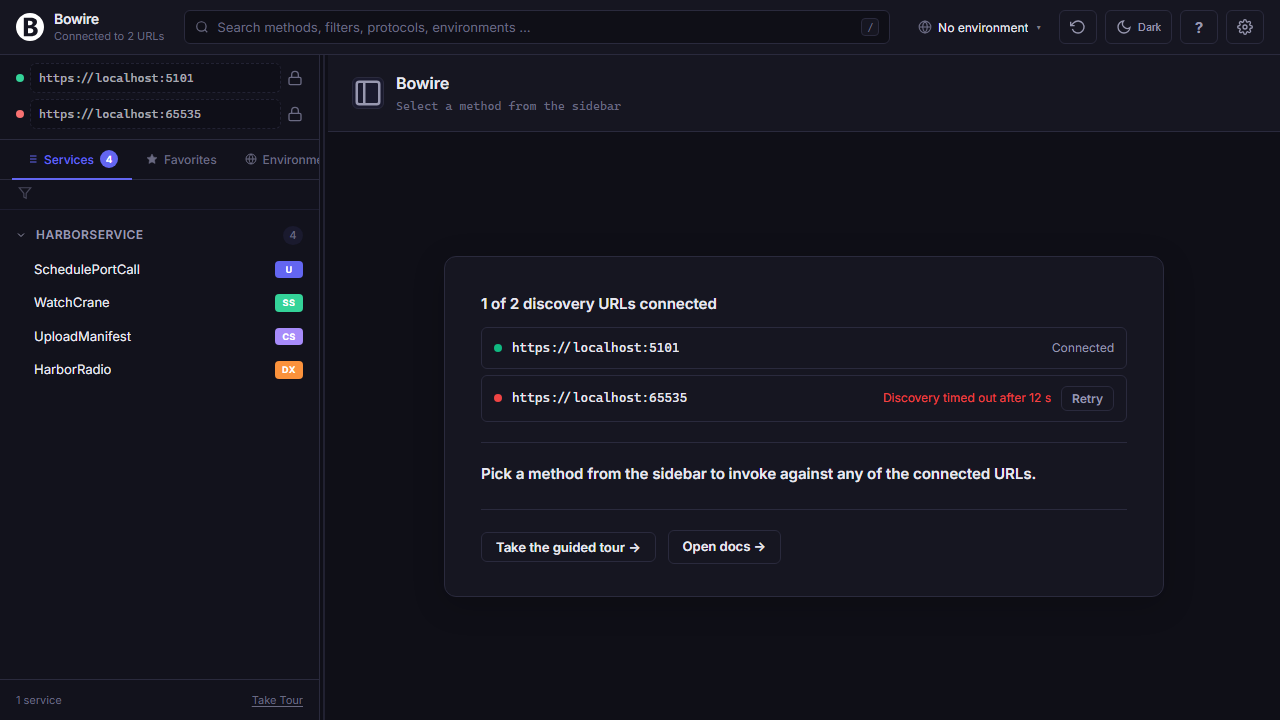
- "X of Y discovery URLs connected" headline
- Status table with green / red dots, the URL, and a Retry button per failed entry
- A collapsed per-plugin diagnostics chip under each failed row (v2.3)
- "Pick a method from the sidebar" hint at the bottom
State 5 — editable-no-services
Editable-mode (no --url flag) with at least one URL configured but
nothing discovered. Per-URL connect list plus an upload-schema
fallback card.
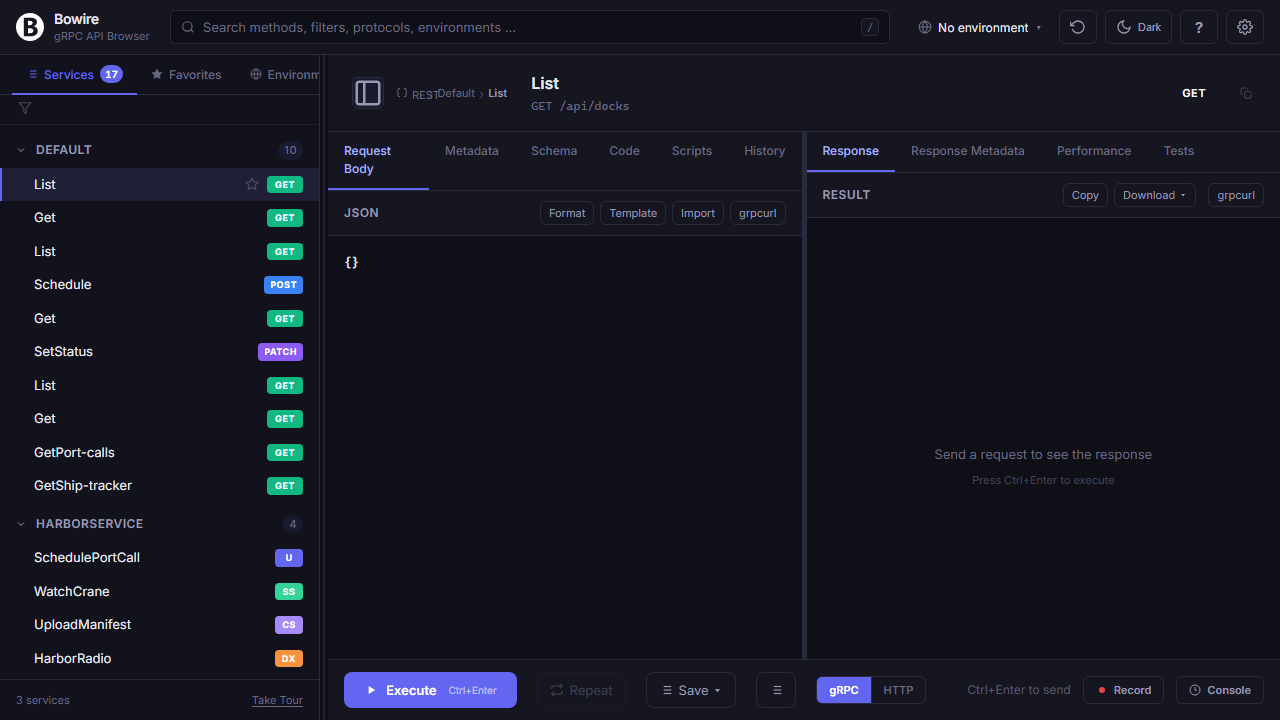
- "No services discovered yet" title with help text
- Per-URL connection status row, each with its own collapsed per-plugin diagnostics chip when that URL produced a failed probe (v2.3)
- Divider, then the upload-schema fallback button
State 1 — wrong-protocol-tab
Legacy name. Bowire no longer shows one tab per protocol — all protocols live in a single sidebar with a dropdown filter. The state ID is kept for backwards compatibility; the trigger is now "the active protocol filter excludes every discovered service".
Services exist but the active protocol filter drops them all (e.g. the user narrowed the sidebar to MCP on a server that only exposes gRPC). Shows one-click buttons to switch the filter to a protocol that has hits.
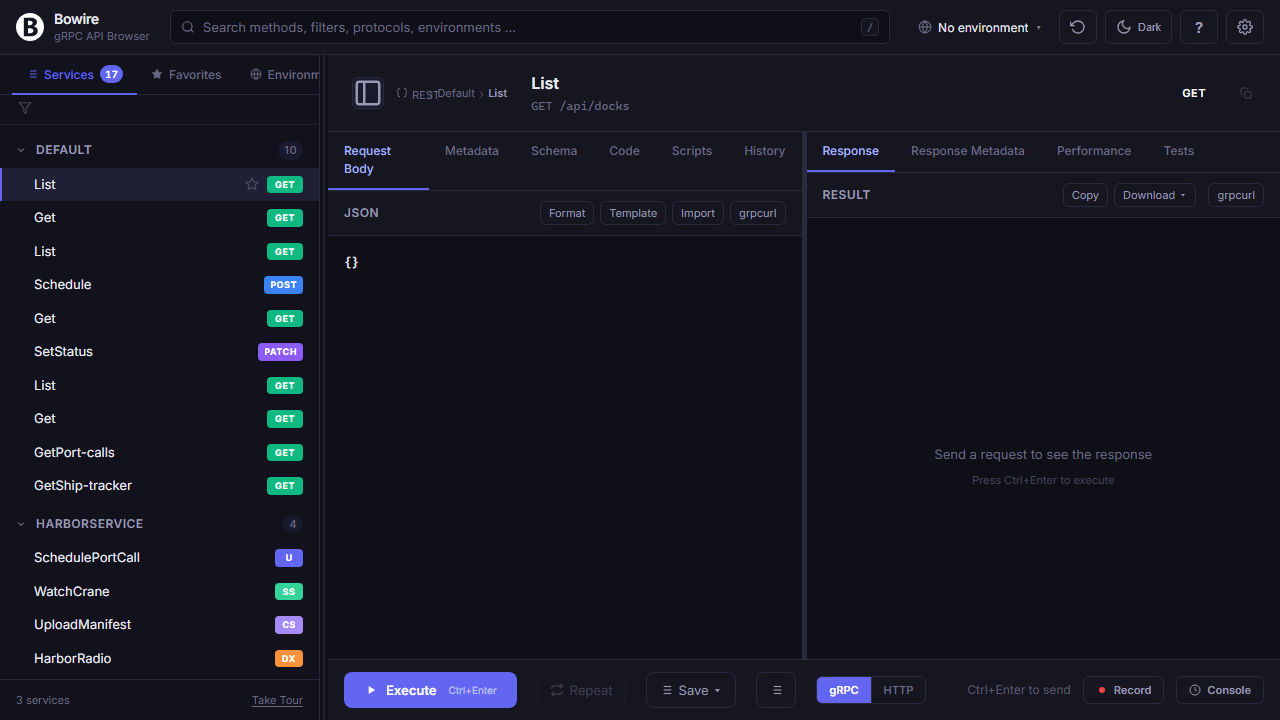
- "No
<protocol>services found" title - One-click switch buttons to the protocols that do have hits (with their method counts)
- Hint about server-side reflection / introspection requirements
State 3 — loading
Discovery is in flight. Animated spinner + the URL being probed + hint about expected first-connection time.
(Captured incidentally during the editable-mode test — happens any
time fetchServices() is mid-call.)
How state detection works
The detection is a small JavaScript state machine in
wwwroot/js/landing.js (detectLandingState) that reads global
state and returns one of the seven state strings. Detection runs on
every render() call, so the landing reacts in real time to
discovery results, connection status changes, retry button clicks,
and tab switches.
States are ordered by precedence — more specific states are checked
first so they win over fallback states. For example, wrong-protocol-tab
is checked before ready so a user who narrowed the protocol filter to an
empty set sees the switch hint instead of the generic "select a method" prompt.
Implementation references
- JS state detection + render:
wwwroot/js/landing.js - Render hook:
wwwroot/js/render-main.jscallsrenderLandingPage(main)wheneverselectedMethodis null - State variables:
serverUrls,services,selectedProtocol,connectionStatuses,discoveryErrors,discoveryAttempts,discoveryHints,discoveryDiagnosticsOpen,isLoadingServices,config.lockServerUrl— all declared inwwwroot/js/prologue.js - Discovery hooks:
wwwroot/js/api.jsfetchServices/fetchServicesForUrlsetisLoadingServicesand write per-URL errors intodiscoveryErrorsso the landing can render them._recordDiscoveryProblemparses the problem+json body intodiscoveryAttempts/discoveryHints; it accepts both the object array current hosts emit and the legacy string array, so a newer workbench pointed at an older embedded host still renders something - Diagnostics renderer:
renderDiscoveryDiagnostics(key, opts)andserializeDiscoveryDiagnostics(key)inwwwroot/js/landing.js. Both return early when the key has no attempts —render()has no try/catch, so every caller must toleratenull